I have been thinking about this most recent discussion more. Actually it's still kind of driving me nuts. It occured to me that there are other forces at work here that need to be explored.
First, McIntire says we should basically use our anger to have something to push against. I think that there is a great deal of validity in this and I've never thought about it this way (stupid me!). This is good advice and utilizing it can help us prove to the world that we do, in fact, have something to say and we might not have the desire to say it in the same way as our predecessors (or we do want to say it like our predecessors a couple of generations removed, take your pick). So from that point of view it's good to have something to push against.
Second, and this is big, is it possible that those of us making this argument are doing a great disservice to the two or three generations of composers before us that worked hard to break free from this kind of dogma to open up new vistas for us, the "younger" generation? This is my fear now. The "live and let live" attitude that began developing in the 1960s helping bring about the "return to tonality" (not that tonality ever actually went anywhere) seems to have, in many respects, come full circle. It seems that now those in what might be referred to as the "tonal majority" are beginning to treat those in the "minority" with furious anger. In a sense doesn't this violate the basic tenets of this philosophy? Are we not wandering into dangerous dogmatic territory of our own? Shouldn't the music itself be the thing and not the means that brought us to that end?
Third, I've found what truly makes me angry. It's not the music. It's not its underying philosophies or techniques. I wish that the subject matter had been presented to me better when I was an undergraduate. I wish someone had taken the time to explain to a me a little bit more about Babbitt's background. I know he's nuts about jazz and musical theatre. I know that Sondheim (genius) is probably his most famous student. I just wish that someone would have placed his ideas into the proper context rather than just said, "Here it is. Deal with it." This angers me a great deal and should I ever have to teach it I know for sure that I would teach it with a much more open mind.
I realize that this music rubs a lot of people the wrong way. Most of it, in fact, doesn't have this affect on me. It's the dogma behind a lot of the music that bothers me. I think my own personal experience with modern music of all kinds has actually been better than a lot of musicians/music students. Perhaps this is because I came to the music of the Second Viennese School and beyond on my own and without any kind of academic pretense. This doesn't keep me from feeling a kind of ambiguity about it though. I like and respect a great deal of the music. I admire much of the complexity. But I also have this deep love of neotonal music representing both postminimalism and the new complexity.
I invite your insults of "waffler" and such, but this entire discussion has given me cause to think about the whole affair a little more.
Monday, February 27, 2006


Thursday, February 23, 2006
Hiatus
Okay kids, I'm going to take a little blogger break for a few days. All this talk of Babbitt and Cage has made me a little crazy. But it's also helped put me in the mood to write. Thanks for the comments.
I'm submitting for a festival a work for violin and piano that I haven't written yet and the deadline is March 1. As in next Wednesday. Am I insane? Maybe. See you on the other side.
I'm also going to listen to my new recording of Sibelius' Kullervo. Don't have it? Get it!
I'm submitting for a festival a work for violin and piano that I haven't written yet and the deadline is March 1. As in next Wednesday. Am I insane? Maybe. See you on the other side.
I'm also going to listen to my new recording of Sibelius' Kullervo. Don't have it? Get it!
Tuesday, February 21, 2006
Taking Up Arms With the Warrior Bard
Before reading this, read this.
This is such dogmatically dangerous ground on which to be treading and yet, as a willing heretical participant, there’s so much to say. Where does one begin?
First let us be fair to Milton Babbitt. He didn’t title his article “Who cares if you listen?” That was the editor of the magazine that did that. Okay, that’s it.
I still don’t put much stock in the subject matter of the article. Is composition a highly specific field? Yes. Does that mean it shouldn’t be accessible? No. Even Schoenberg knew that if he was going to write his music using the system he devised that he still had to place an emphasis on clarity. No matter how abstract, his music should be comprehensible to more than just the most highly trained of all composers (about 6 people). One would also be remiss not to mention the incorporation of the human element into Schoenberg’s music. And Webern shouldn’t be blamed, either. His music is incredibly inspired and well crafted. It was the post-WWII serialists who took Webern’s work and codified it to its utmost extremes.
“The sad thing is, this school of thought has become dogmatic for any scholarly composer. If you disagree, you're narrow-minded…what's the point of discussing, if we're not going to really discuss anything? They don't want discussion; they want conformity.” - Tim
"Any attempt to codify musical reality into a kind of imitation grammar (I refer mainly to the efforts associated with the Twelve-Tone System) is a brand of fetishism which shares with Fascism and racism the tendency to reduce live processes to immobile, labeled objects, the tendency to deal with formalities rather than substance. Claude Levi-Strauss describes (though to illustrate a different point) a captain at sea, his ship reduced to a frail raft without sails, who, by enforcing a meticulous protocol on his crew, is able to distract them from nostalgia for a safe harbor and from the desire for a destination.”
-Luciano Berio, Meditation on a Twelve-Tone Horse
I understand that the older generation grew up with this method. We get it. There was no other way. Beyond all this, though, is something that is much more subversive and sinister. Whilst the strictures of academia have loosened in recent years there is still this frighteningly dogmatic adherence to the music/teachings of Babbitt, Cage, Stockhausen and Boulez, even if only in theoretical form, in the upper echelons of academia. I’ve been thinking about this for years. Literally. I have thought for a long time now that the kind of conformity that came to be expected of composers after World War II is dangerous and fascist. You will do it this way! Isn’t this the kind of thinking that started that war in the first place? You will not question. You will acquiesce. The perfect society is a conformist society.
What’s worse is that this attitude developed (and, to a point, persists today) in a time where a lot of interesting things were happening musically outside of Darmstadt. That school basically turned a blind eye to all of it. There is no dialogue between proponents of total serialism and other musics. None. What does exist is merely a monologue which places no value on the influence of popular forms. Are you going to tell me that the likes of Miles Davis, George Gershwin, John Coltrane and Thelonius Monk don’t deserve to be placed with the most brilliant of their academic counterparts? If that’s the case I beg to differ. Furthermore I’m not sure if I would want to be associated with those that might actually think this.
I respect serialism, just as any thoroughly trained composer who learned how to utilize it should. I even enjoy incorporating serial elements into my own compositions from time to time. But I can’t bring myself to surrender all creative control (not to mention my humanity) to a formula that merely expresses one’s intellect and totally discounts one’s personal experiences. Don’t get me wrong. I’m not saying that Babbitt’s music has no value. Like all previous music, it has historical and theoretical value when taken into the whole of musical history. To me total serialism is largely empty and devoid of meaning.
The faculty nearly bit the heads off of anyone who remotely insinuated anything anti-Babbitt. So... what's the point of discussing, if we're not going to really discuss anything? They don't want discussion; they want conformity.
When the subject of Babbitt and his teachings comes up there is no discussion. You accept everything or you are a heretic. When our teachers talk about him all of a sudden there is this reverential tone and he is spoken of as if he were some kind of Promethean figure bringing fire and knowledge to we mere mortals.
Now here's my two cents:
The conformity demanded by the proponents of total serialism amounts to little more than the dogmatic practices of musical terrorists who would rather blow up the entire world for the sake of their empty god than admit that there might be other paths to musical expression that are capable of coexisting. - Brad Fowler
“Alas, this industrialized twelve-tone horse, dull on the outside and empty inside, constantly being perfected and dragged to a new Troy in shadow of an ideological war long since fought and won by responsible minds like Schoenberg, with neither systems nor scholarship for armor!"
-Berio, “Meditations…”
Tuesday, February 14, 2006
I Hate Writing About Me
Okay, that's not entirely true. When it comes to this blog, I tend to write a lot about me. Then again, it's my blog and I'll cry if I want to. Oh wait...there was a point here.
Anywayyyy...
I'm submitting a couple of scores for a new music festival in the fall and, along with those scores, recordings, program notes, etc., I have to include my bio. I hate doing this. How does one write about one's achievements without sounding smarmy? Beyond that, I have so little real experience at this thing that my bio kind of looks pathetic. Granted it's an opportunity to talk about myself and what I've supposedly done, but it's still annoying. I think McIntire wrote about this previously. A lot of people - especially composers - will pad their resume with the slightest contact of a "name". It's kind of like a native American coup (sp?) stick. Sometimes you'd whack somebody over the head with it in battle for glory and honor. Sometimes you'd just touch someone who was already on the ground dead and claim it for yourself. I met Krzysztof Penderecki after a Chicago Symphony concert in 2000, do I get to put that on my resume? I think there are some unscrupulous composers who probably would. But the fact of the matter is that, at this point in my life, there's only one person with whom I've actually studied who has had a direct influence on my writing. I also don't expect that to change anytime soon.
Friday, February 10, 2006
Happy Birthday, Jerry
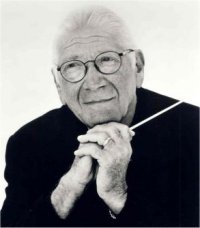
Jerry Goldsmith (1929-2004) is still my favorite film composer. It's still kind of sinking in that I'm never going to see another new movie poster with his name on it. I love John Williams' music. Bernard Herrmann was a genius. But few others have been quite adept at being so chameleon-like in their ability to genre jump.
With that in mind, we'll be enjoying a good mix of standards andthe more obscure works of Mr. Goldsmith's output. Afterall, Jerry Goldsmith is to me what John Williams is to the Pikey. I have lots.
The Omen
Rio Conchos
QB VII
Take a Hard Ride
In Like Flint/Our Man Flint
Alien
Star Trek: The Motion Picture
Rudy
Basic Instinct
First Knight
The 13th Warrior
and.....
Christus Apollo (cantata for orchestra and chorus based on writings of Ray Bradbury, 1969)
Music for Orchestra (commissioned and premiered by Leonard Slatkin and the St Louis Symphony, 1970)
Fireworks (written as part of Jerry's first concert series with the LA Philharmonic, 1999)
Thursday, February 09, 2006
A Sad Day For Godzilla
The composer that defined the sound of the Godzilla films has died. According to the BBC online, Akira Ifukube died of multiple organ failure today. He was 91.
Wednesday, February 08, 2006
Happy Birthday, Johnny
 Happy 74th Birthday to the Maestro.
Today's Playlist celebrates John Williams who is arguably the most famous living composer in the world (like it or not, which I do!).
Raiders of the Lost Ark
Superman
E.T.: The Extra-Terrestrial
Star Wars
Schindler's List
Harry Potter and the Prisoner of Azkaban
And let's not forget a few concert works:
The Violin Concerto
Treesong for Violin and Orchestra
Cello Concerto
So listen to some Johnny today!
Friday, February 03, 2006
Film Score Friday 2/3/2006
Today's Theme: Music from films directed by or adapted from Michael Crichton.
Coma - Jerry Goldsmith, 1978
The Great Train Robbery - Jerry Goldsmith, 1979
Jurassic Park - John Williams, 1993
Congo - Jerry Goldsmith, 1995
Twister - Mark Mancina, 1996
The Lost World: Jurassic Park - John Williams, 1997
Sphere - Elliot Goldenthal, 1998
The 13th Warrior - Jerry Goldsmith, 1999 (Graeme Revell score rejected)
Jurassic Park III - Don Davis, 2001 (themes by John Williams)
Timeline - Brian Tyler, 2003
Timeline - Jerry Goldsmith, 2003 (unused)
Enjoy!
Thursday, February 02, 2006
Rotations, Just for Fun
composer
Set 1:
composer
omposerc
mposerco
posercom
osercomp
sercompo
ercompos
rcompose
composer
Set 2:
co mp os er
oc mp os er
oc pm os er
oc pm so er
oc pm so re
Set 2':
co mp os er
mp os er co
os er co mp
er co mp os
co mp os er
Set 2":
co mp os er
mp os er oc
os er oc pm
er oc pm so
oc pm so re
Set 3:
com poser
omc oserp
mco serpo
com erpos
omc rpose
mco poser
com oserp
omc serpo
mco erpos
com rpose
omc poser
mco oserp
com serpo
omc erpos
mco rpose
com poser
Set 4:
comp oser
ompc sero
mpco eros
pcom rose
comp oser
Set 4':
comp oser
ompo serc
mpos erco
pose rcom
oser comp
serc ompo
erco mpos
rcom pose
comp oser
Tuesday, January 31, 2006
Reincarnation
 Die Frau and I spent Sunday watching the entire Lord of the Rings trilogy. We like to do this every once in a while, just to have something to do for an entire day.
Anyway, we were sitting there in the middle of The Two Towers when I had an epiphany:
In my next life I want to come back as Bernard Hill.
Now I know what you're thinking so stick with me on this one for a second.
If reincarnation is what happens to us when we die (which is possible, though I'm not actually sure how I feel about it) then why is it not possible to break the supposed "rules" of space/time and travel back instead of forward since you're dead anyway? Isn't it possible that I could say, "No, I think I'm going to go back, just to be different"? Why not? Then again, time is supposedly the only constant in the universe (unless you're traveling near the speed of light, then it gets really messed up) so it might not be possible.
Either way, Bernard Hill is one bad mother...
And We're Back...
Die Frau and I have finally returned from the Missouri Music Educators Association meeting at the beautiful Tan-Tar-A Resort in Osage Beach, Missouri. Well, we've been back since Saturday. And the disclaimer on the "beautiful Tan-Tar-A Resort" thing is that it would have been beautiful had it been June.
Anywayyyyyyy...
Her kids (well, hers and J's) performed Friday morning. It was a huge success and the outpouring of response was pretty overwhelming.
Let's back up...
Every year there are two or three performances out of, I don't know, 50, that just completely rise above everyone's expectations. Let's just say, this was one of those performances. But I'm not going to steal my wife and J's glory, so I'm going to leave it at that. Hopefully she'll post about it on her own blog.
Anyway, the rest of the convention was, for the most part, quite a letdown. There were 5 ensembles that performed to which I was in some way connected. I'm pleased to say that all of them performed incredibly well (this is me being proud). Beyond that there was only one other performance that really captured my interest.
I suppose the most disappointing thing is that in recent years programming at this meeting has become utterly conservative. This is especially true in the band and orchestra areas. It seems as though few are willing to take the chance and give a gutsy or adventurous performance. I heard about 5 bands play and all but one left me pretty cold regarding both their programming and performance.
The highlight of the weekend (for my ears) was the Truman State University Wind Symphony. Naturally I'm biased as a former student, but I also believe I have the ability to see beyond those things to hear the performance for what it is. It wasn't good. It was absolutely superior.
Overall, though, the convention was pretty disappointing. But we still managed to have a good time. We caught up with old friends, made new ones and, rather importantly, I made good contacts with a lot of potential. Heheheh...
Friday, January 27, 2006

Tuesday, January 24, 2006
Film/Music Meditation
Recently the Warrior-Bard (also known as my dear friend Tim) posted about his thesis composition, a work far from finished, but completed in draft form. First, good on him for getting it done because it's a pretty big accomplishment. In describing the genesis of his thesis he had the following to say:
"Film music can--and does--stand alone, apart from the events of a film (especially when it appears on the album in a concert form instead of chopped into three scenes throughout the film, as is the case with Toccata and Dreamscapes). But this is another discourse entirely, one I don't have time for at the moment. I can let Brad field that one..."
First of all, thanks to the almighty Warrior-Bard (and his anger, which has made him powerful)for giving me today's topic. We'll explore three common fallacies of film music.
1. Film music isn't supposed to draw attention to itself.
2. Film music that is "emotionally manipulative" is bad film music.
3. Film music isn't intended to exist outside of the film/music diegesis.
1. Film music isn't supposed to draw attention to itself.
"Experts" seem to think this is true. The "best" film music shouldn't draw any attention to itself ever. I think that this is slightly misplaced. I think what these "experts" want to say is "film music should be subtle enough that it doesn't force me to feel a specific emotion". While we'll tackle this shortly I want to address the first issue. The "best" film music is that which the composer and/or director has chosen the appropriate time to allow the music to play in the background or come to the foreground and help tell the story on another level. If the "best" film music isn't supposed to draw attention to itself, why is the music from Star Wars a perennial favorite? Because it's good music. That's why.
2. Film music that is "emotionally manipulative" is bad film music.
I had an interesting discussion with a young filmmaker when I was in Los Angeles last June (that's another posting) about "emotionally manipulative" music in film. His argument was that he felt that he disliked a lot of film music because of this. So we engaged in an interesting debate/discussion. This conversation took place shortly after he had seen both of the films that evening (both of which I scored) and was surprised that 1) I had written "actual music" and 2) it didn't shove his emotions around. I think I was eventually able to convince him that some people that think that "emotionally manipulative" music is being considered in the incorrect context. My point to him was that just because a cue is emotionally involved doesn't mean that it's trying the manipulate the emotional response of you, the listener/viewer. Perhaps the composer was trying to express the emotional response of the character or, heaven forbid, the overall situation. Or maybe he/she is actually portraying their own musical/emotional response to the scene they're scoring. Ultimately, though it is the character and not you, the audience, that is the important thing (in good film, anyway).
3. Film music isn't intended to exist outside of the film/music diegesis.
Perhaps this was the original intention of film music; that it should/could/would never live outside of film, that it was the ultimate gebrauchtsmusik. Can you extract an entire score for a concert performance? Perhaps. Should you? Not really. Not unless it's a colossal work such as Lord of the Rings or Star Wars where there is an abundance of music to choose from. (Anymore, though, I'd be more interested in hearing film music outside the construct of the film in which the composer has gone back and reworked the material into something that is more concert-like, just to prove his/her composition skills. Think about it, Korngold's Violin Concerto is based on themes from his film scores that were recast in more traditional symphonic form.).
For me this is perhaps the most important of the three because I don't have to see the movie first in order to appreciate how great the music can be all on its own. Actually I would say that between 10-15% of my film score recordings are from films that I've never seen. But I like the music. Does seeing the movie make the listening experience more valuable? Of course it does. But sometimes you have a real stinker of a movie with a really tremendous score (did I hear someone say Cutthroat Island?) and you like listening to it for whatever reason. Ultimately it means that it resonates with you and that is a deeply personal thing.
As is all art.
Friday, January 20, 2006
Film Score Friday 1/20/2006
Today's theme is music from the films of Paul Verhoeven.
That'll be fun.
The playlist:
Flesh and Blood (Basil Poledouris)
Robocop (Basil Poledouris)
Total Recall (Jerry Goldsmith)
Basic Instinct (Jerry Goldsmith)
Starship Troopers (Basil Poledouris)
Hollow Man (Jerry Goldsmith)
++++++++++++++++++++++++++++++++++++++++++++++++++++++
AND ANOTHER THING!!!
I have taken the liberty of adding a countdown clock to my sidebar indicating how long it will be until the end of the "Mozart Anniversary Year". This is probably the most fun I'll have with Amadeus all year!
Wednesday, January 18, 2006
Those English Blokes Can Play!
This past Saturday the Royal Philharmonic Orchestra was in town. The Pikey and I went and heard them.
Wow! We have a great orchestra ("Wow, what a terrific awwwdience!") here, but there's little that beats the calibre of those English kids sawing away.
The program:
Sibelius: Finlandia
Mozart: Concerto no. 5 for Violin ("Turkish")
Sibelius: Symphony no. 2
I guess you start by saying that the concert was awesome. Unfortunately it's going to be February before I go to a concert where there's no Mozart involved. I suppose I can live with that. The violin soloist, though, left a lot to be desired. There seemed to be a disagreement about pitch between her and the orchestra. It was painful and I winced a lot. Also it seemed that she played a little more romantically than one would like for Mozart and her tone was thin. Other than those things I guess she was pretty good! Oh.
Anyway, the Sibelius was all tremendous. For the budding film composers out there if you don't know Sibelius you should. This is especially true if you like Michael Kamen or James Horner. The brass section just rocked. Maybe a little out of balance. Just a smidge. Teeny tiny.
But still awesome.
What else does one say? It's the Royal Philharmonic Orchestra, England's self-proclaimed "national orchestra". They're pretty much some of the best players on the planet. I guess, though, there's also a sense of complacency that goes with this particular territory because the concertmistress looked pretty bored much of the time. When she wasn't playing she was fidgeting with her brastrap or trying to clean out her nose. At least she used a tissue.
Tuesday, January 17, 2006
Yay!!!
Congrats to Johnny on his 4th Golden Globe last night. I think that Memoirs of a Geisha is probably one of the most beautiful, if sparse, scores he's written in a long time.
Any other thoughts on the awards?
Any other thoughts on the awards?
Friday, January 13, 2006
Film Score Friday the 13th
Supposedly all sorts of fantastical things happen on Friday the 13th. What better way to have a Friday the 13th than celebrate the genius that is Bernard Herrmann? Today's playlist includes:
The Egyptian (20th Century Fox, 1954)
The Ghost and Mrs. Muir (20th Century Fox, 1947)
Jason and the Argonauts (Columbia Pictures, 1963; 1999 re-recording on Intrada, Bruce Broughton, Sinfonia of London)
Taxi Driver (Columbia Pictures, 1976)
Psycho (Universal, 1960; 1997 Varese Sarabande re-recording, Joel McNeely, Royal Scottish National Orchestra)
The Seventh Voyage of Sinbad (Columbia Pictures, 1958; 1998 Varese Sarabande re-recording, John Debney, Royal Scottish National Orchestra)
Journey to the Center of the Earth (2oth Century Fox, 1958)
The Day the Earth Stood Still (20th Century Fox, 1951)
Vertigo (Paramount, 1958)
North by Northwest (MGM, 1959)
Thursday, January 12, 2006
Namedropper!!!

In the spring of 2000 some friends of mine and I decided that, rather than go somewhere sunny and warm, we were going to have a "cultured" spring break and headed to the Windy City for a week. We did all the things you're supposed to do when you visit Chicago. We went to the Sears Tower, the Chicago Art Institute (could've spent days in there), Navy Pier (it always rains the day I go to Navy Pier), the Field Museum of Natural History, Pizzeria Uno (duh...you can't go to Chi-town without getting great pizza), did lots of shopping (mostly at the Virgin Megastore, which I preferred at the time to refer to as the Virgin Meccastore), and pretended to be German when approached by homeless people.
But...
For me the absolute highlight of the week, though, was attending the Chicago Symphony's American premiere(?) of Krzysztof Penderecki's Seven Gates of Jerusalem. This hour-long work is amazing with truly incredible performing forces as well. It calls for doubled wind/brass/percussion sections on stage. This group of winds and brass is doubled again at the back of the concert hall as an antiphonal group. The percussion section also has in it two sets of giant PVC pipes that are cut to different lengths and struck on the end with fly swatter-type things. Then there's a 200-voice choir that is, at one point, split into 3 mixed choirs. Then there are 6 soloists; a lyric soprano, a dramatic soprano, mezzo-soprano, tenor, bass and cantor.
The work itself is in 7 movements. All of the text is taken from the Old Testament and performed in Latin except the 5th movement which is intoned by the cantor in Hebrew. This is probably the most striking of the seven movements because of the Hebrew cantor and the conspicuous use of bass trumpet (awesome!) which Penderecki uses to symbolize the voice of God (as a trumpet player I'm not going to disagree). Mr. Penderecki was the guest conductor for the evening as well and the other work on the program was Schubert's Symphony no. 9 "The Great". Let's just say this about his conducting; anyone who has watched Howard Shore conduct on the extra features on the Lord of the Rings dvds will understand what kind of conductor Mr. Penderecki is. He has one conducting "dynamic" which is a rather huge window. And he conducts left-handed. While this isn't a bad thing, it's quite distracting.
Seven Gates of Jerusalem is the piece that really got me turned on to Penderecki's music. After that I went on this buying spree where I picked up a whole bunch of Penderecki recordings which ultimately led me to many other composers of Eastern Europe and the Baltic Region (you may have noticed).
And the second greatest part of the evening (after the music) was the shot above. That's yours truly with Penderecki. Mercifully my hair and sense of style has changed since then. I hope.
Tuesday, January 10, 2006
Tuesday, January 03, 2006
King Kong!!!
So die Frau and I finally went and saw King Kong a couple weeks ago with Oscar and her Boo. A day late and a dollar short but here it is anyway...
What can one possibly say about one of the most amazing "popcorn" movies ever seen? I thought the movie was terrific. The only real gripe I had was the same as everyone else. The subplot with the kid. I'm going to take the opposite stance of most people though. I think that if you're going to go to the trouble of putting the subplot in the film then you should develop it as fully as you can. That, of course, gets you into the sticky realm of how much does one develop a subplot so that it doesn't become the story itself? Anyway, some people thought that the whole bit with the kid should have been left out. Sure it didn't advance the plot but when most of the movie actually is plot-based (that's refreshing) it's nice to have a diversion even when it ties in.
Did that make sense? I don't care.
I also thought that some of the dialogue ranged from ridiculous to leaden and overly serious. I thought that James Newton Howard's score (covered previously) worked quite well in the film. Was it an earth-shattering, groundbreaking work? No. For that matter, was the music for Lord of the Rings? Think about it. Anyway, I thought the music worked fine, I just wish that he could have come up with better tunes. It would have been nice to have something a little more grandiose, but what do you expect for 3 weeks work?
And then there's Naomi Watts. I've never seen her in anything else (no I haven't seen The Ring, Ring 2 or I Heart Huckabee's) but I can't help but think one of two things; 1) she's an incredible actress or 2) she takes direction extraordinarily well. I think it's probably a little of both. I think this because no one else in the movie has to interact with a non-existent Kong more than she does.
Kong is incredible. The characterization in the animation is absolutely astounding. I thought the eyes were especially terrific because you knew the moment that he died that it had happened because of the way his pupils dilated. The fur was great. It seemed like every aspect of Kong was well researched, planned and executed.
Overall you just get the sense that Peter Jackson really did want to make this movie for the past 35 years. It was lavished with so much attention and love that it was a wonderfully engaging moviegoing experience.
A friend of mine and I were joking that, since the technology exists and PJ is such a great director of both actors and computer generation, he should be allowed to remake Episodes I-III of Star Wars "The way they were meant to be seen!".
Subscribe to:
Posts (Atom)